

How Black History Teaches Us a Theology of Liberation
Reclaiming a faith that stands with the oppressed
Contributor: Jemar Tisby, PhD, via Substack
The spirit of justice throughout Black history was not sustained by optimism, it was sustained by theology.
For generations, Black people in the United States faced systems designed to break their bodies and their spirits.
From enslavement to racial terrorism, to segregation, to voter suppression—in every era of U.S. history, the white power structure tried to convince them that racial oppression was natural, inevitable, even Christian.
But Black Christians refused to accept that version of religion.
They interpreted the faith differently.
They read the Bible with the eyes of the oppressed. And from those readings they developed a theology powerful enough to sustain the struggle for freedom.
Beneath the truth-telling, the institution-building, the political coalition-building, and the disciplined nonviolent resistance that fueled the Black freedom struggle was something even deeper—a theological conviction that God stood with the oppressed and called them to resist injustice.
This conviction eventually came to be known as Black Liberation Theology.
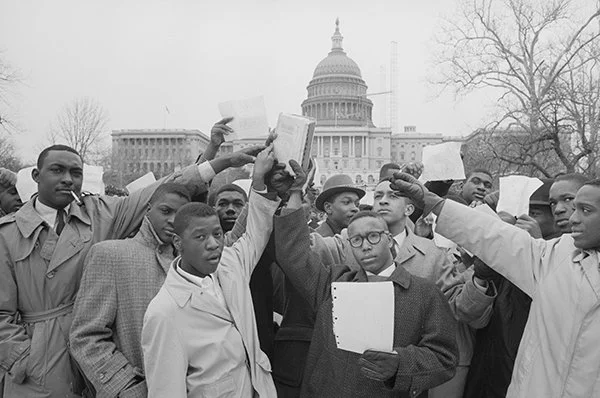
Photo Credit: Warren K. Leffler, 1960 | Library of Congress
Black Liberation Theology
Black liberation theology names racial oppression for what it is and declares God’s solidarity with those who suffer under unjust systems.
It insists that faith is not meant to produce compliance with injustice but courage to confront it.
Liberation theology is faith that fuels resistance to unjust systems rather than submission to them.
Few people articulated this theology more clearly than James Cone, widely considered the founder of Black Liberation Theology.
Cone wrote and taught during the turmoil of the Civil Rights and Black Power movements. He watched as many white theologians debated abstract questions about doctrine while Black communities were fighting for their lives.
Cone had little patience for a theology that ignored the suffering of real people.
As he once put it:1
“For me nothing was at stake in European theology. It didn’t matter whether Barth or Harnack was right. I wasn’t ready to risk my life for that.”
Christ Is Black
For Cone, theology had to matter in the real world.
It had to speak to the conditions people actually faced. That is why he made the provocative claim that “Christ is Black.”
Cone did not mean that Jesus of Nazareth was literally a Black man in terms of the amount of melanin in his skin. He meant that Jesus identifies with those who are crushed by systems of power.
To say “Christ is Black” is to say that Christ stands with the oppressed rather than the oppressor.
In that sense, Jesus is Black wherever people are suffering under injustice. Jesus is a Black person under white supremacy. Jesus is Palestinian under occupation. Jesus is a migrant at the border. Jesus is a prisoner behind bars.
Christ stands wherever human dignity is denied.
Cone developed this insight even further in his landmark book The Cross and the Lynching Tree.
In it he wrote the haunting words: “The lynching tree is America’s cross.”
For Black Americans, the cross was never merely a symbol of personal salvation. It was a symbol of unjust suffering imposed by a violent society. And yet, it was also a symbol of hope.
Cone explained it this way:
“It was Black people’s identification with the cross that kept many of them out of a madhouse.”
The cross revealed something essential about the nature of God. As Cone wrote,
“The cross is a paradoxical symbol because it proclaims that hope comes by way of defeat, that suffering and death do not have the last word.”
That is the theology of the Black church in a sentence.
Out of no way, God makes a way.
Out of crucifixion, God brings resurrection.
Black liberation theology insists that God is not neutral in the face of injustice. The divine presence is found on the side of those who struggle for freedom.
Cone wrote that:
“The cross is God’s critique of power—white power, male power, all power that abuses.”
This theology did not exist only in books or classrooms. It was lived out in the lives of freedom fighters who saw their activism as an expression of faith.
J. Deotis Roberts and a Theology of Power
Another important voice in this tradition was J. Deotis Roberts, a theologian who helped expand and refine Black liberation theology in the years after James Cone’s earliest writings.
Roberts shared Cone’s conviction that theology must confront the realities of injustice, but he also emphasized that liberation should ultimately lead toward genuine reconciliation between people.
Yet Roberts was clear that reconciliation could never be achieved by ignoring oppression. Justice had to come first.
For Roberts, theology that remains confined to private spirituality is not only insufficient; it can become complicit in injustice.
Faith, he argued, must move believers beyond personal religious experience into collective action for justice.
As Roberts wrote:3
“We cannot rest in a private and intense religious experience that does not lead us to public action against oppressed structures of power. A privatized, quietistic version of theology is inadequate for the oppressed. What we need is a political theology. A theology of power.”
Roberts was pushing back against a form of Christianity that treated faith as something purely personal and concerned only with individual salvation or inner spiritual life.
The gospel calls believers not only to personal devotion but to a public witness that challenges systems that deny people dignity and freedom.
Roberts’s work deepened the liberationist tradition by reminding the church that faith cannot remain neutral in the face of injustice.
If theology does not confront oppressive power, it fails the very people the gospel claims to serve.
Prathia Hall’s Freedom Faith
Another person who extended Black liberation theology in new directions was Prathia Hall.
Born in Philadelphia in 1940, Hall grew up as a preacher’s daughter. Her father founded Mount Sharon Baptist Church, and the church was the center of her childhood.
From an early age, Hall absorbed the conviction that faith and justice belonged together.
She later described the spiritual foundation of her activism this way:4
“I was raised by my parents in what I believe to be the central dynamic in the African-American religious tradition. That is, an integration of the religious and the political. It is a belief that God intends us to be free, and assists us, and empowers us in the struggle for freedom.”
For Hall, the stories of Black history reinforced that conviction. The testimonies of enslaved people, abolitionists, and civil rights activists showed her that faith was never meant to be passive.
“We were called,” she said, “to be activists in this struggle for justice.”
Hall described her theology with a simple but powerful phrase: “freedom faith.”
Freedom faith is “the belief that God wants people to be free and equips and empowers those who work for freedom.”
That belief sustained generations of Black Christians. It helped them endure suffering that might otherwise have crushed them. And it gave them the courage to challenge systems of oppression that seemed immovable.
Resisting Authoritarianism
The lessons of this theology are not confined to the past. They speak directly to the challenges of the present moment.
Authoritarian movements thrive when people believe that resistance is futile or that religion encourages obedience to unjust power.
But Black liberation theology offers a different vision.
It reminds us that the gospel calls believers to confront systems that degrade human dignity.
When governments attempt to silence truth, suppress democratic participation, or target vulnerable communities, a faith rooted in liberation refuses to cooperate with injustice.
Instead, it insists that defending freedom is a spiritual responsibility.
The same theology that sustained the Black freedom struggle can also sustain those who resist authoritarianism today.
Theology Is Never Neutral
This is how Black history teaches us a profound lesson about faith.
Theology is never neutral.
Every theology either blesses oppression or challenges it. Every interpretation of Christianity either protects the powerful or stands with the vulnerable.
Black Christians chose the latter. They reclaimed the gospel as a message of liberation and built a faith strong enough to resist injustice.
And they left us with a lesson that still matters today.
God takes sides, and God is on the side of justice.
